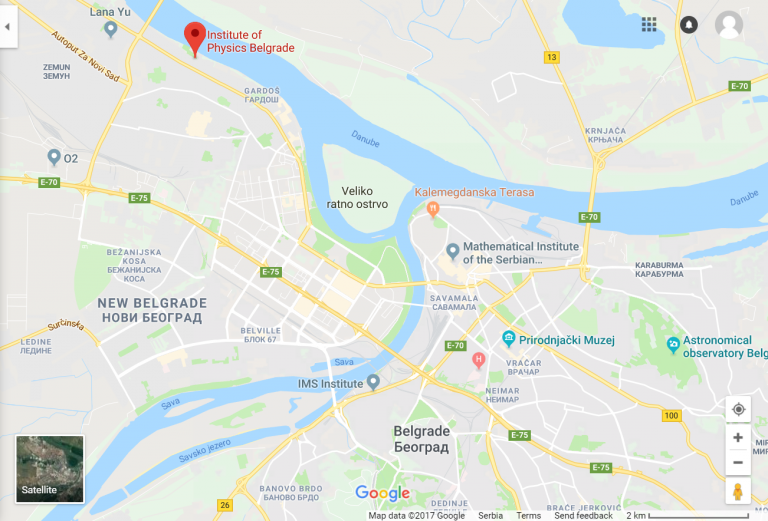
Milica give a lecture at PHOTONICA 2025 conference held at Serbian Academy of Science and Arts in Belgrade from 25th August to 29th August 2025. The title of the talk was Enhancement of LIBS Signal via NELIBS and LIPSS for Biomedical Applications while the abstract of the talk is given below:
Laser-Induced Breakdown Spectroscopy (LIBS) has emerged as a promising technique for elemental analysis in complex matrices, including biological fluids. However, its sensitivity – especially for trace elements – remains a critical limitation when targeting subtle biochemical differences such as those potentially associated with neurodevelopmental disorders like Autism Spectrum Disorder (ASD) [1]. In this context, signal enhancement strategies are essential to increase LIBS performance
and unlock its potential in clinical diagnostics. In this work, we present our preliminary results on two distinct signal enhancement approaches: Nanoparticle-Enhanced LIBS (NELIBS) and the application of Laser-Induced Periodic Surface Structures (LIPSS). Both methods aim to improve signal intensity and reproducibility in LIBS measurements by altering the physical properties of the substrate or sample–substrate interface. Our experimental setup involves the analysis of aqueous PbCl₂ solutions and blood serum
microdroplets deposited and dried on solid substrates. For NELIBS, substrates were functionalized with noble metal nanoparticles, known to facilitate localized plasma confinement and improved ablation efficiency. In parallel, LIPSS were fabricated on the same substrates using controlled laser irradiation, creating periodic nanostructures that enhance light–matter interaction during plasma generation. The enhanced LIBS spectra were compared with conventional LIBS for both PbCl₂ and serum
samples, focusing on signal-to-noise ratio, emission intensity, and spectral reproducibility. Our findings confirm that both NELIBS and LIPSS contribute to notable signal enhancement. The observed enhancements suggest increased sensitivity for trace element detection in complex biological fluids. These results represent a first step toward applying advanced LIBS-based techniques for biomedical diagnostics. The long-term objective of our research is to develop a robust metallomic profiling method capable of detecting elemental biomarkers potentially associated with ASD. Future work will focus on applying these optimized LIBS protocols to real blood serum samples from pediatric subjects with ASD and neurotypical controls. This study highlights the promise of physical and chemical substrate modifications for pushing the analytical limits of LIBS and opens new perspectives for its application in non-invasive and rapid diagnostic workflows.
[1] J.K. Kern et al, Journal of Trace Elements in Medicine and Biology 38 (2016) 8.