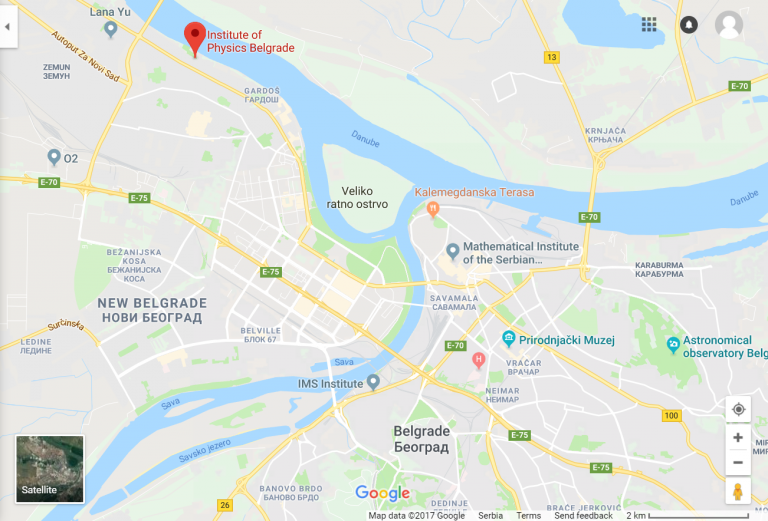
The paper on in – situ LIBS measuring head accepted in Measurement Science and Technology
 The paper with core idea of IDEJE project NOVA2LIBS4fusion, the functional measuring head for in – situ low pressure LIBS applications, has been published in Measurement Science and Technology journal. With this publication, all work carried under this project has been published, and project was successfully brought to the end.
Popular lecture by Biljana at Kolarac Foundation
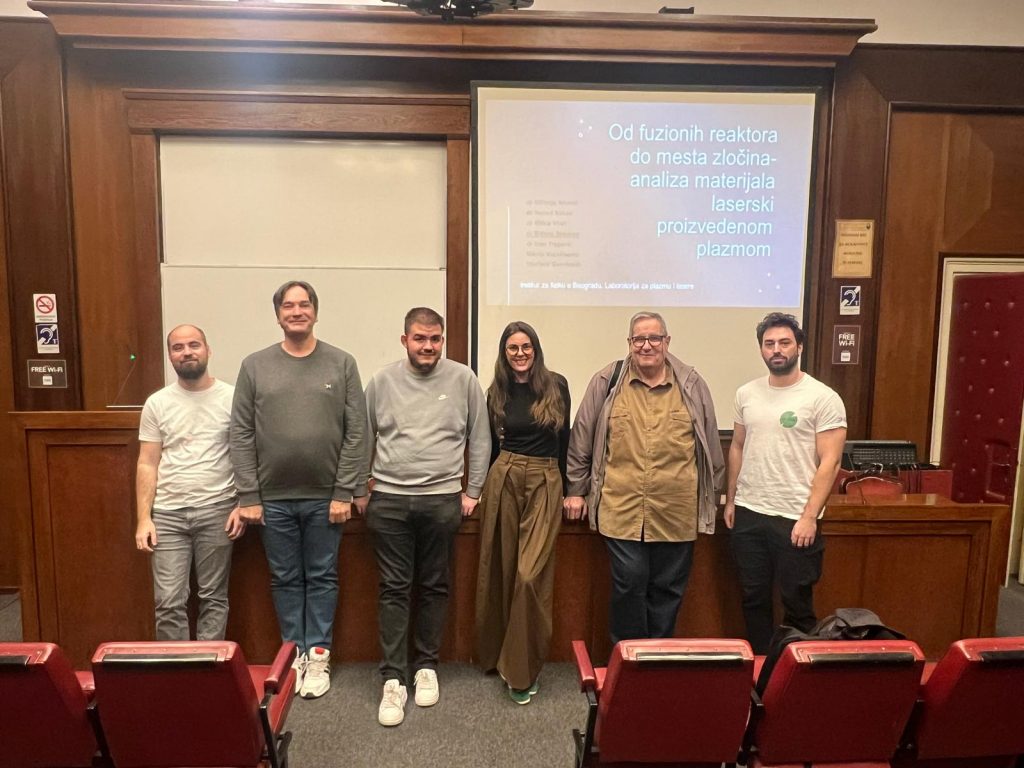
On Monday, 16th March, Bilja held a public popular lecture “From Fusion Reactors to Crime Scene – Material Analysis with Laser Produced Plasmas” about the work done in our Lab during the past couple of years at Kolarac Foundation in Belgrade. Lecture is a part of the series of popular lectures “Under the quantum light” (Serb. “Pod kvantnom svetlošću”) organized by Institute of Physics Belgrade and Photonics Center. The abstract of the talk was (in Serbian):
Dr Biljana Stankov će na svom predavanju predstaviti deo istraživanja Laboratorije za lasere i plazmu Instituta za fiziku u Beogradu, koja se bave analizom materijala primenom laserski proizvedene plazme. Predavanje „Od fuzionih reaktora do mesta zločina – analiza materijala laserski proizvedenom plazmom” će objasniti šta se dešava kada laserski impuls pogodi materijal i kako nastala plazma omogućava da se „pročita” njegov sastav. Kroz zanimljive primere, biće prikazano kako se ova metoda primenjuje u mnogim oblastima, od fuzionih istraživanja pa do forenzičkih analiza. Cilj predavanja je da se publici približi kako se svetlost i plazma koriste kao moćni alati za razumevanje materije u savremenoj nauci.
New publication by Nikola
Nikola’s work on his PhD thesis is now in full swing. We are pleased to share that a new paper entitled “Detection of hydrogen isotopes in fusion-relevant targets using laser ablation and microwave-induced plasma” related to his doctoral research has just been published in European Physical Journal Plus, in collaboration with our colleagues and partners from INFLPR Romania (LSPI Laboratory and EPPA Laboratory) as well as the Vinca Institute of Nuclear Sciences.
This achievement marks an important milestone in his research progress, and we are proud to see the continued success of this collaboration. We wish Nikola the very best of luck in his future work and look forward to the next results from his PhD journey.

New paper by Nenad and his collaborators
Nenad, together with his coworkers, has just published the paper entitled “Potentially Toxic Elements in the Soil of an Urban Area in Croatia: A Multimethodological Approach for the Assessment of Mobility, Environmental and Human Health Risks” in Archives of Environmental Contamination and Toxicology. We congratulate him on this achievement and wish him more success in the future!
Biljana published new paper
Another paper entitled “Acoustic Signatures in Laser-Induced Plasmas for Detection of Explosives in Traces” connected with work that Biljana did during her stay at ENEA has just been published in Sensors. We congratulate her on this achievement and wish her more success in the future!
New paper by Biljana and her coworkers
 Biljana’s trip to ENEA Italy gave its first results. The paper entitled “Transferable calibration coefficients for semi-quantitative analysis by Laser Induced Breakdown Spectroscopy (LIBS) in samples containing calcium“ has been just published in Spectrochimica Acta Part B: Atomic Spectroscopy. We congratulate her and wish her more success in the future!
Milica participated at the Italy – Argentina round table
The Italy – Argentina round table under the working title Advances in Laser Induced Breakdown Spectroscopy (LIBS) applications was held on 17.10.2025. at the University of Bari, Department of Chemistry. Milica held a lecture titled “LIBS for the determination of trace metals in oils”.
Milica participated at the 13th International Conference on Photo-Excited Processes and Applications (ICPEPA-13)

13th International Conference on Photo-Excited Processes and Application was held at the Castle of Charles V in Lecce, Italy, from September 14 to 19, 2025. Milica participated with a poster entitled LIBS Analysis of Oils: A Spin-Coating Approach for High Sensitivity and Matrix Effect Suppression, while the abstract of the poster is given below:
We present a methodology for the preparation and elemental analysis of oil samples using Laser-Induced Breakdown Spectroscopy (LIBS), designed to reduce matrix effects and sample
volume while improving sensitivity and repeatability. The sample preparation involves stabilizing both the oil and a silica wafer substrate at a fixed temperature of 40 °C, followed by deposition of an oil droplet on substrate rotated by a spin coater, thus producing uniform thin films with tunable thickness governed by rotation speed [1].
This approach enables consistent sampling, independent of the oil’s kinematic viscosity, and ensures a reproducible interaction volume for LIBS. Comparative measurements on pure oil and oil samples containing various elements revealed that matrix effect is significantly mitigated in thin oil films. For ultra-thin layers (~0.74 μm), the LIBS signal—particularly the carbon line—becomes stable and insensitive to impurity concentration, a key indicator of minimized matrix interference. Furthermore, pulse-to-pulse stability and electron density were significantly enhanced compared to bulk liquid targets, due to better plasma confinement [2]. Despite the minimal ablation volume (~0.3 nL per pulse), strong plasma emission was achieved. Using optimized delay times and line-specific calibration, we attained detection limits as low as 3.9 ppm for Zn, 0.49 ppm for Cd, 0.16 ppm for Cu, and 0.082 ppm for Cr. This method provides a highly sensitive and efficient pathway for trace elemental analysis in oil-based matrices [1].
References:
[1] M. Vinić, E. Aruffo, F. Andreoli, M. Ivković, V. Lazic, Spectrochimica Acta Part B: Atomic
Spectroscopy, 164, 105765 (2020)
[2] M. Vinić, M. Kuzmanović, J. Savović, M. Ivković, Journal of the Serbian Chemical Society 88 (2),
153 (2022)
Milica participated at the PHOTONICA 2025 conference
Milica give a lecture at PHOTONICA 2025 conference held at Serbian Academy of Science and Arts in Belgrade from 25th August to 29th August 2025. The title of the talk was Enhancement of LIBS Signal via NELIBS and LIPSS for Biomedical Applications while the abstract of the talk is given below:
Laser-Induced Breakdown Spectroscopy (LIBS) has emerged as a promising technique for elemental analysis in complex matrices, including biological fluids. However, its sensitivity – especially for trace elements – remains a critical limitation when targeting subtle biochemical differences such as those potentially associated with neurodevelopmental disorders like Autism Spectrum Disorder (ASD) [1]. In this context, signal enhancement strategies are essential to increase LIBS performance
and unlock its potential in clinical diagnostics. In this work, we present our preliminary results on two distinct signal enhancement approaches: Nanoparticle-Enhanced LIBS (NELIBS) and the application of Laser-Induced Periodic Surface Structures (LIPSS). Both methods aim to improve signal intensity and reproducibility in LIBS measurements by altering the physical properties of the substrate or sample–substrate interface. Our experimental setup involves the analysis of aqueous PbCl₂ solutions and blood serum
microdroplets deposited and dried on solid substrates. For NELIBS, substrates were functionalized with noble metal nanoparticles, known to facilitate localized plasma confinement and improved ablation efficiency. In parallel, LIPSS were fabricated on the same substrates using controlled laser irradiation, creating periodic nanostructures that enhance light–matter interaction during plasma generation. The enhanced LIBS spectra were compared with conventional LIBS for both PbCl₂ and serum
samples, focusing on signal-to-noise ratio, emission intensity, and spectral reproducibility. Our findings confirm that both NELIBS and LIPSS contribute to notable signal enhancement. The observed enhancements suggest increased sensitivity for trace element detection in complex biological fluids. These results represent a first step toward applying advanced LIBS-based techniques for biomedical diagnostics. The long-term objective of our research is to develop a robust metallomic profiling method capable of detecting elemental biomarkers potentially associated with ASD. Future work will focus on applying these optimized LIBS protocols to real blood serum samples from pediatric subjects with ASD and neurotypical controls. This study highlights the promise of physical and chemical substrate modifications for pushing the analytical limits of LIBS and opens new perspectives for its application in non-invasive and rapid diagnostic workflows.
[1] J.K. Kern et al, Journal of Trace Elements in Medicine and Biology 38 (2016) 8.
Nikola and Ivan participated at BPU 12 conference
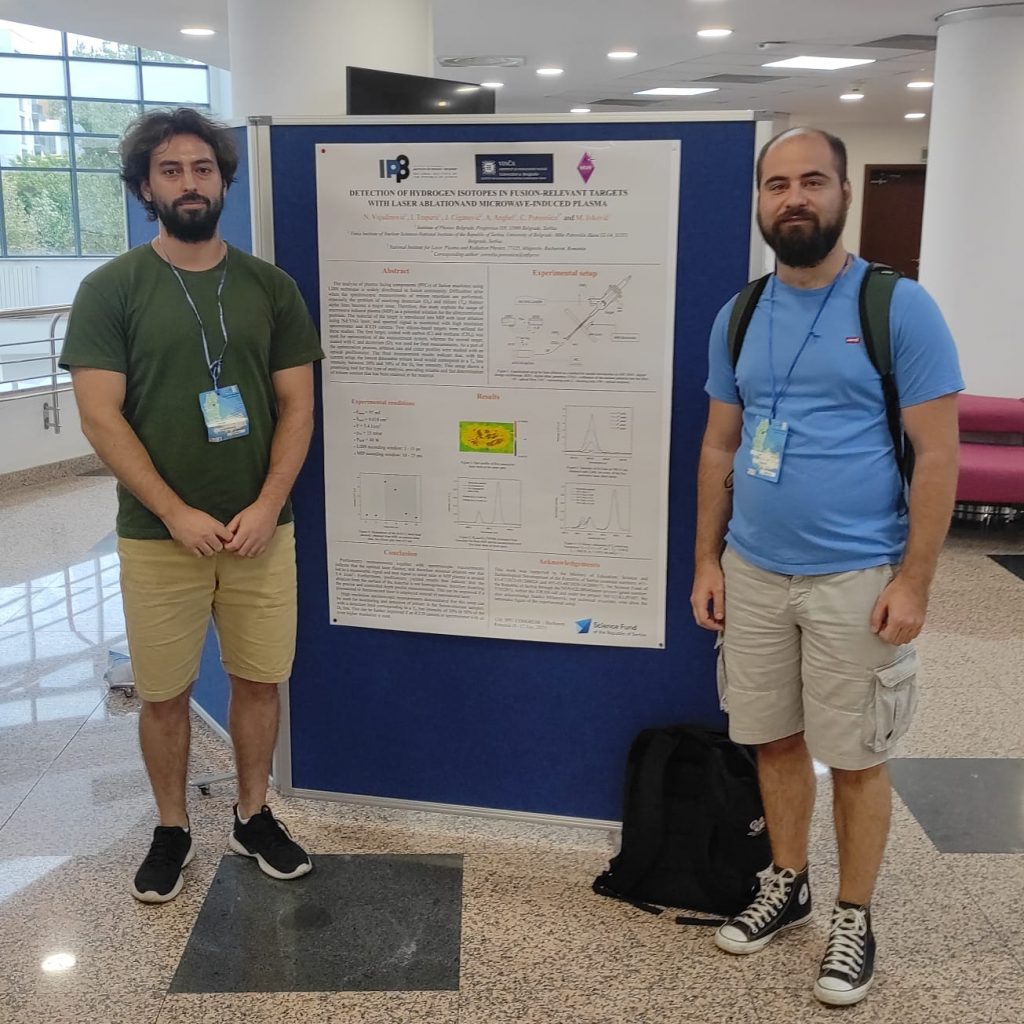
12th International Congress of the Balkan Physical Union (BPU 12) was held at National University of Science and Technology POLITEHNICA in Bucharest, Romania from 8th to 12th July 2025. Nikola and Ivan participated with a poster entitled Detection of Hydrogen Isotopes In Fusion-Relevant Targets with Laser Ablation and Microwave-Induced Plasma which is the joint work with colleagues from Low Temperature Plasma Laboratory at National Institute for Laser Plasma and Radiation Physics (INFLPR), Romania and Vinca Institute of Nuclear Sciences. Here Nikola presented part of his results obtained in pursue of his PhD thesis. Also, Nikola achieved the award for one of best 20 posters presented at the conference. The abstract of the poster is:
The analysis of plasma facing components (PFCs) of fusion machines using LIBS technique is widely distributed in fusion community. Difficulties arise when the spectroscopic measurements of tritium retention are performed, especially the problem of resolving deuterium (Dα) and tritium (Tα) Balmer alpha lines become a major issue. Therefore, this study exploits the usage of microwave induced plasma (MIP) as a potential solution for the aforementioned problem. The material of the target is introduced into MIP with laser ablation using Nd:YAG laser, and spectral signal is monitored with high resolution spectrometer and ICCD camera. Two silicon-based targets were utilized for these studies. The first target, coated with carbon (C) and methane (CH4), was used for optimization of the measurement system, whereas the second target, coated with C and deuterium (D), was used for final measurements. As a part of the optimization process, ablation rate and crater profiles were studied with an optical profilometer. The final measurement results indicate that, with the current setup, the lowest detectable tritium level would correspond to a Tα line intensity between 30% and 50% of the Dα line intensity. This setup shows a promising tool for this type of analysis, providing reliable and fast determination of tritium content that has been retained in the material.